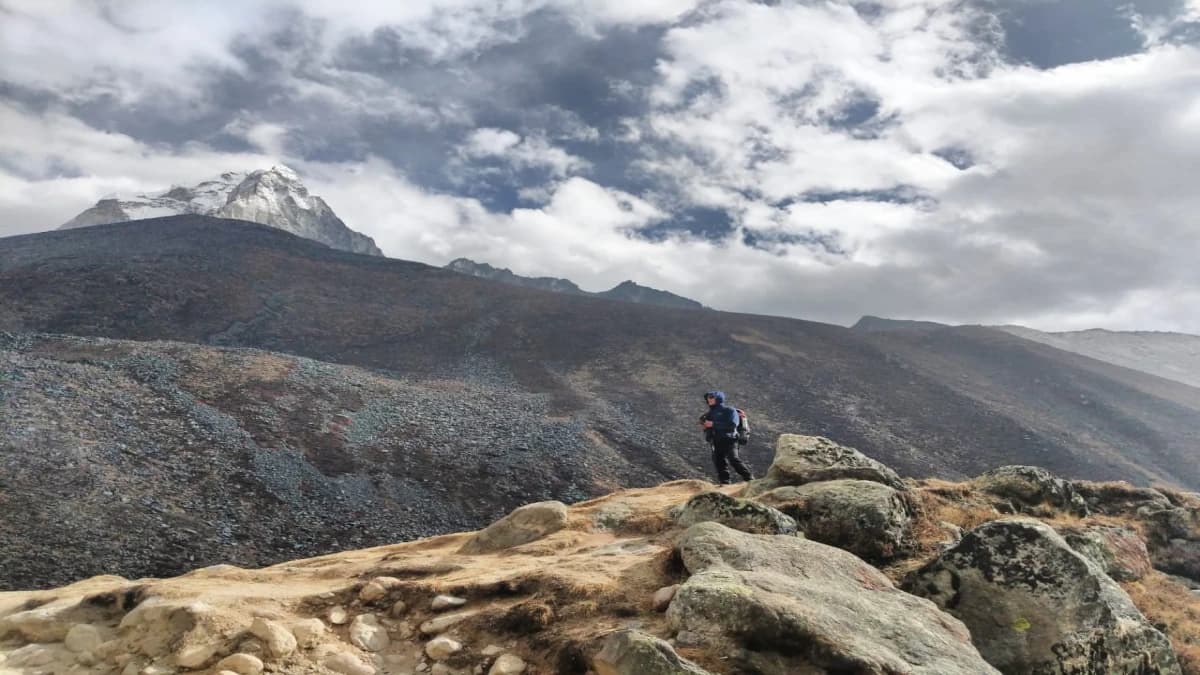
Everest Base Camp Solo Trekking
Everest Base Camp Solo Trek is a journey that remains at the top of almost every trekker's wishlist and for a good reason. A solo trek to Everest Base Camp, shapes a very personal journey with just you and the majesty of Khumbu region. Walking to Everest Base Camp solo, passing through ancient Sherpa settlements, monasteries, glaciers and standing at the foothills of Mount Everest (8,848m) is a once in a lifetime experience.
Are you also dreaming of doing the Everest Base Camp Trek solo? Maybe you are wondering if solo trekking to Everest Base Camp is even possible at the moment. Let’s learn about if we can even do an Everest Base Camp Solo Trek in 2026.
Fortunately, Everest Base Camp Solo Trekking is absolutely possible and one of the most popular ways trekkers visit the base camp. Despite the rule of April 1, 2023 which required every trekker to hire a guide for conservation areas and national parks, the Everest region doesn’t fall under it. Now we know that trekking to Everest Base Camp solo is possible, let’s get the detailed picture behind this.
With this solo trekking guide 2026, let’s talk about the rules you need to follow for a safe and legal Everest Base Camp Solo Trek experience.
Everest Base Camp Possible for Female Solo Trekker?
Yes, a solo trek to Everest Base Camp in 2026 is possible from a legal standpoint. Unlike other trekking regions in Nepal, Everest region doesn’t follow the licensed guide mandate rule which is confirmed in writing by the authority. Here's the reality behind the decision.
In April 2023, Nepal Government and NTB brought a new rule requiring a trekking guide in every national park and conservation area, including the Sagarmatha National Park. It was intended for the safety of trekkers and conservation of the fragile ecosystem of protected regions. But the Khumbu Pasang Lhamu Rural Municipality which handles the Everest region didn’t stand by that rule.
The local body that governs tourism inside Sagarmatha National Park, publicly rejected that rule. It issued its own notice stating clearly that solo trekking to Everest Base Camp and other routes in the Everest region is absolutely still legal. And, the local government has run its own independent entry system ever since.
Due to this reason, Everest Base Camp Solo Trek is legally possible and a thriving practice on the trails. This means that trekkers walk at their own pace and explore Everest’s beauty in solitude without any groups.
Is Everest Base Camp Trek Without a Guide Legal?
Yes, you can legally do the Everest Base Camp Trek without a guide as of 2026. The mandatory licensed guide rule which was imposed by Nepal Tourism Board and Nepal Government doesn’t apply when solo trekking to Everest Base Camp. The Khumbu Pasang Lhamu Rural Municipality issued a formal notice confirming that hiring a guide is not mandatory for trekking in the Everest region.
The Everest region operates under its own local permit system. It is separate from the mandatory guide rule that now applies while solo trekking to Annapurna or solo trekking to Langtang. As long as you have the correct Everest Base Camp Trek permits, you are legally free to trek to Everest Base Camp independently, without hiring a guide.
Also, you don’t need to hire a guide to obtain these permits. You'll see many trekkers on the trail walking alone with just their permits and gear. Namche Bazaar, Dingboche and Lobuche all see a steady stream of independent trekkers walking without a hired guide and checkpoints do not turn them away for that reason.
A guide is not required but how practical is trekking to Everest Base Camp without a guide? Can a trekker possibly reach Everest Base Camp independently? Of course, but is it practical and safe? Let’s now discuss this as many trekkers wanting to do an EBC independent trek face this dilemma.
You can legally trek to EBC without a guide. When you trek independently, you tackle navigation, altitude sickness, logistics and rescue yourself. This involves many risks in case something goes wrong with no signal and help around. Hence, although guides are not needed on paper, they provide expert safety and support throughout your solo trek in the Khumbu region.
This is the approach that we actually suggest. Even after hiring a guide, you still have your independence entirely. The guide will just be there to assist you with navigation, permits, logistics and to monitor altitude sickness symptoms and prioritize health and safety. They are also first-aid trained and can arrange rescue and help immediately if situations require. The guide doesn’t take away from your freedom of an independent and Everest Solo Trekking.
Attractions of Trekking Solo to Everest Base Camp
-
Walk through Sherpa villages, pine trees, rhododendron forests and high alpine terrain entirely at your own pace.
-
Freedom to set your own daily schedule with the safety net of a licensed guide if you prefer.
-
No group dynamics, no waiting on slower hikers, no compromising on acclimatization days.
-
A flexible itinerary where you can add a side trip and take extra days for rest and relaxation away from daily life’s stress.
-
Experience a deeper exploration, quieter self-reflection and authentic interaction with Sherpa people and the trails of Khumbu without a crowd around you.
-
A personal and empowering experience knowing you conquered the base camp of the world’s highest mountain solo.
What can you Expect from an Everest Base Camp Solo Trek?
A solo trek to Everest Base Camp gives you the freedom of exploring the Everest region at your own will and preference. You will have control over entirely everything from pace, rest days, itinerary as well as side trips. It includes all the takeaways of a normal trek and enhances that experience with a more personal and meaningful journey.
When you are solo on the journey to Everest Base Camp, there will be no need of adjusting to a group, their pace and walking distance. You also won’t have to compromise the experience you want due to a fixed itinerary. If you want to take longer and soak-in the majestic views or rest at a certain stop for self-clarity to reflect and admire the journey, it becomes possible when you trek solo. From solo trekking to Everest Base Camp, you can expect and experience trekking at your own comfort and preferences.
You can experience and immerse in the culture of the Sherpa people at a deeper level without the barrier of a large group. You will have the freedom and independence of making unplanned decisions on the trails. You won’t be in any rush to reach the next teahouse unlike when trekking with a group or agency. This happens more than you would expect. Trekking with a group rushes daily hiking and because of that you are at the teahouse by noon with nothing to do. Instead with a solo trek, enjoy and explore at your own pace, stop at where you please, admire the views and take longer to soak-in and reflect upon the journey.
By trekking solo to Everest Base Camp, you can expect and achieve fewer distractions and deeper connections with the trails, people, rhododendron forests, high alpine terrain, majestic glaciers and peaks like Everest, Lhotse, Nuptse and Ama Dablam inside Sagarmatha National Park.
You will achieve self-reflection and gain confidence and a sense of achievement after conquering Everest Base Camp alone. This gives you a chance to disconnect from your routine life and witness the beauty and spirituality of the Khumbu, from the prayer flags at Tengboche Monastery to the sunrise over Everest from Kala Patthar.
Is Everest Base Camp Solo Trekking Safe?
Yes, trekking solo to Everest Base Camp is relatively safe as it is the country’s most popular and crowded trek. That is even if you trek independently or solo with a guide, it is safe. Even when you are on a solo trek to EBC, the trails are not empty unless you choose the absolute off-season. The trails and routes are well-marked, teahouses are plentiful and terrain is also not difficult which makes it safe to trek alone. You will see and hike past other trekkers so you won’t be in complete isolation from a safety standpoint.
Apart from that, the altitude profile can make it difficult to trek to Everest Base Camp Solo. It is a trek that demands good physical fitness and mental resilience. Also, it has long walking days and exposes you to higher altitude up to 5,545 meters which carry a probable risk of altitude sickness.
Many people have done it safely and it is still much popular to trek solo to EBC. Trekkers without a guide are mostly fine but they have to manage everything on such high altitude themselves. It can be difficult to arrange help and rescue where there is no signal and where the air is thin making you lose focus.
So unless you are an experienced trekker who has completed high altitude treks like this before, it is better to hire a guide for safety. Going solo but guided makes a lot of difference, even though you are not legally required to. An expert and licensed guide will take care of your acclimatization, watch you for altitude symptoms, verify your permits, arrange accommodations seamlessly and in case of emergency, coordinate a helicopter evacuation immediately. It doesn't slow you down or turn your solo trip into a group trip. Having a guide just makes it much safer given the many risks.
If you do decide to trek independently, be sure to carry travel insurance with proper policies. Also share your daily itinerary and location with someone back home, and always walk at your natural pace. The mountains will be right there waiting for you even if you take longer to reach the base camp.
Everest Base Camp Female Solo Trekking
Everest Base Camp Solo Trekking for Females is a very popular and trendy option. It's one of the most popular routes in Nepal for solo females trekking alone. Along the trail, you will see many female independent trekkers thriving along the trail. The Sherpa communities are very much used to hosting solo female trekkers and giving them a safer and comfortable experience.
Everest is a busy trekking region and the trails are popular, well-marked with average development. This alone makes it safer for females trekking solo to Everest Base Camp. Moreover, people are absolutely welcoming, respectful and hospitable. Even with that you must be careful with prior preparation. As a female solo trekker, the risks you may face are difficulty in navigation, managing your health, securing proper accommodation and so on. Bad weather and higher altitude is the one to look out for.
We advise you to first look out and decide your accommodation. It is very important that your teahouses are well reviewed so that you have the highest safety and comfortability. If possible within your budget it is better for a solo female trekker to book a private room instead of a twin sharing room. On the trail, try to stay close to other trekkers or groups if you are unsure about navigation. It is very important that you acclimatize properly to adjust to the elevation gain so give yourself enough rest days. You also should trek gradually and start early so that you can reach the next stop before it becomes dark and unsafe.
If you are trekking for the first-time, you should definitely go with a guide. Their expert support is absolutely important during proper navigation, selecting better accommodations, handling permits, managing altitude sickness symptoms and arranging an immediate rescue or helicopter evacuation if anything goes wrong. It is also possible to hire a female trekking guide if you'd feel more comfortable having a person of the same gender along you when trekking solo. Most of the top agencies in Kathmandu offer female guides and porters specifically for this reason. This can make teahouse stays, shared dining rooms, rest stops and the whole dynamic feel more comfortable and relaxed.
It is important to dress modestly in Sherpa villages and monasteries out of respect for local Tibetan-Buddhist customs. Also keep a paper copy of your permits, guide contact and emergency numbers separate from your phone for safety reasons. Most Everest Base Camp Solo Female trekkers call it one of the safest and most comfortable treks in Nepal and it indeed is for the reasons we just learned.
What Permits are Needed for Everest Base Camp Solo Trekker ?
When you are solo trekking to Everest Base Camp, you only need two permits which are the Sagarmatha National Park Entry Permit and the Khumbu Pasang Lhamu Rural Municipality Entry Permit. Since, the rural municipality rejected the mandatory guide requirement, you don’t need the TIMS card for this trek. Also, both these permits for Everest Base Camp solo trek are obtainable as an independent trekker without needing a guide.
1. Sagarmatha National Park Entry Permit
This permit is required for entry into Sagarmatha National Park, the UNESCO World Heritage Site and the home of peaks like Everest, Lhotse, Nuptse, Ama Dablam, Khumbu icefall and glacier and Gokyo alpine lakes. You will have to verify your permits at the checkpoint in Monjo which is the park entry gate.
It costs NPR 3,000 per person (around USD 22 to 30) for foreign nationals and NPR 1,500 per person for SAARC nationals. Children under the age of 10 aren’t charged with the permit fee.
2. Khumbu Pasang Lhamu Rural Municipality Entry Permit
This is the local municipality's own permit that has allowed the independent trekkers to enter the region without a licensed guide. It funds community development and infrastructure in Sherpa villages along the trail and is issued at Lukla or the Monjo checkpoint rather than in Kathmandu.
It costs NPR 3,000 per person (around USD 22 to 30) for foreign nationals.
There is uncertainty surrounding whether you need the old TIMS card too or not. As rules can change, it is better to confirm the current requirement with the Tourism office or a registered trekking agency in Kathmandu before your trek.
Everest Base Camp Solo Trek Cost
The cost of a Everest Base Camp Solo trek ranges around USD 1,000 to 1,200 for an independent trek and around USD 1,200 to USD 1,400 when you hire a guide and porter. The cost also depends on your trek duration, extra days on the trail and the level of comfort you want along the way. Here's a rough breakdown of how much you can expect to pay:
1. Sagarmatha National Park Entry Permit: NPR 3,000 (approx. USD 22)
2. Khumbu Pasang Lhamu Rural Municipality Permit: NPR 3,000 (approx. USD 22)
3. Kathmandu to Manthali Airport by shared jeep: USD 20 to 22 per person (each way)
4. Manthali to Lukla Airport flight: USD 200 per person (each way)
5. Kathmandu to Lukla Airport flight: USD 250 to 255 per person (each way)
6. Teahouse accommodation: USD 5 to 15 per night
7. Meals: USD 20 to 35 per day
8. Extra expenses (Wi-Fi, charging, hot shower, drinking water, etc.): USD 8 to 15 per day
9. Licensed guide: Around USD 25 to 30 per day
10. Porter: Around USD 20 to 25 per day (shared between 2 trekkers)
These reflect the average prices for the 2026 trekking season and it can vary by the standard of service you choose.
How to Prepare for Everest Base Camp Solo Trekking?
It is very important to ensure proper preparation for going on a solo trek to Everest Base Camp. Trekking in the Himalayas requires careful planning, physical as well as mental preparation. When you trek solo either independently or by hiring a guide, it is even more important to prepare everything yourself.
You can prepare for Everest Base Camp Solo Trek by the following measures:
-
Develop your physical fitness, cardio and strength 2 months prior to the trek as it is of longer duration at high altitudes.
-
Build focus, mental resilience and a strong determination to achieve your dream of solo trekking to EBC as it can become lonely and you may think of quitting.
-
Pack your bag lightly in a smart way and keep important items and leave unnecessary items back home.
-
Do not forget important documents like your permits and passport, also keep them safe.
Packing List for Everest Base Camp Solo Trek
The packing list for a solo trek to Everest Base Camp should be smart and contain every essential gear, equipment along with clothing at a light weight. Packing light and smart is the most valuable tip which we can give to a solo trekker. When you are trekking solo, there won’t be porters to carry your heavy bags. You will be trekking with your own backpack. So, it is very important to keep your bag light and comfortable to carry for over a week of trekking at such high altitude. Try to keep the weight to the maximum of 12 kg. When doing that make sure to pack all the essentials and leave unimportant items back home.
You can pack your bags for your Everest Base Camp solo trek by taking help of the sample packing list with most essentials as below:
Documents
-
Passport
-
Everest Base Camp Trek permits
-
Nepalese rupees (in cash)
-
Comprehensive travel insurance
Clothing
-
Trekking shirts and pants (convertible for warmer sections)
-
Moisture wicking base layer
-
Insulation layer
-
Outer layer
-
Waterproof and windproof pants and jackets
-
Quick dry and breathable undergarments
-
Woolen hat or beanie
-
Sun hat or cap
-
Thermal Gloves
Footwear
-
Sturdy and worn-in trekking boots (waterproof)
-
Comfortable sandals or slippers for evenings at teahouses
-
Moisture wicking woolen trekking socks
Equipment, Gear and Medicines
-
Duffel bag
-
4 season sleeping bag for cold nights near base camp
-
Water bottle (reusable)
-
Trekking poles
-
Everest Base Camp Trek map and offline maps in your device
-
Compass for direction
-
Head lamp
-
Sunglasses with UV protection
-
Raincoat
-
Power bank
-
Basic first-aid kit
-
Water purification tablets
-
Sunscreen SPF 50+
-
Lip balm SPF
-
Prescription medications (if any)
Personal hygiene
-
Quick dry small towel
-
Toothbrush and toothpaste
-
Biodegradable soap
-
Hand sanitizer
-
Wet wipes
-
Tissue paper
Tips for Solo Trekking to Everest Base Camp
-
Research and gain information about the trail, route, trekking distance, altitude gain, accommodation and so on.
-
If you are a beginner trekker, hire a guide but go solo without a group to get full independence on the trail with expert support in case of emergency.
-
Carry the valid and essential Sagarmatha National Park permit and Khumbu Trek Card to ensure you are trekking legally.
-
Inform about your daily itinerary and location to someone back home.
-
Do not forget to bring a good Everest Base Camp Trek Map with distance and elevation as well as download an offline map such as (Maps.me).
-
Walk at a gradual pace without rushing to adjust to altitude naturally. Take enough rest and fit acclimatization days in your itinerary.
-
Keep a day or two as buffer days for the highly weather dependent Lukla flight which experiences delays and cancellations frequently.
-
Make sure you get comprehensive travel insurance that covers high altitude trekking and helicopter evacuation. This is a non-negotiable.
-
For your trek, carry sufficient cash in Nepalese rupees from Kathmandu or Namche Bazaar.
-
Be sure to pack good quality gear like trekking poles, a good sleeping bag and layered clothing as weather can be warmer and chillier on the same day.
-
Keep your permits and passport safely in a waterproof bag and where it is easily accessible.
-
To catch the best views, start your trek early in the morning.
-
Carry water purification tablets or water filters and also a reusable water bottle for conserving the environment.
-
Try to reach the next teahouse before dark for safer navigation.
Final Thoughts on Everest Base Camp Solo Trekking
The reality is that although a nationwide ban on trekking independently in protected regions was brought, the local government didn’t accept the claim. This made Everest region the only protected zone in Nepal where trekking solo without a guide is officially and explicitly allowed. An Everest Base Camp Solo Trek is absolutely doable independently or you can also hire a guide if you prefer. Either way, you have complete freedom and independence during the journey and do not need to join any groups.
Even though trekking independently to Everest Base Camp is allowed, unless you are a pro trekker with lots of prior experience, it is better to go solo but guided. That way you keep your independence, your own pace, your own itinerary and add a licensed guide who covers the altitude, logistics and risk management that can be difficult alone.