Everest Three High Passes Trek - 20 Days

Everest 3 High Passes Trek
Trip GradeStrenuous
Duration20 Days
CountryNepal
Maximum Altitude5,545m
ActivitiesTrekking
Group Size12
StartsKathmandu
EndsKathmandu
Best TimeAutum, Spring

Everest Three High Pass - Demanding High Altitude Trek in Nepal

Everest Three High Passes Trek is one of the most thrilling high-altitude trekking adventures in the Everest region of Nepal that you’ll experience in your life. This 3 passes trek takes you deep into the heart of Everest region where you can find mighty Himalayas, snow-capped peaks above the clouds including the world’s highest peak itself, warm hospitality of Sherpa communities where you get to immerse in their culture and tradition. If you’re thinking of trekking in Nepal in 2025/26, Everest Three Passes Trek is waiting to test your limits as you’ll explore the nature and its beauty in Nepal's Everest region. Immerse into this adventure with Himalaya Arirang Trek to experience the high-altitude mountain passes along with peaceful charm of remote Himalayan culture of Nepal. Explore and discover one of the most unique and incredible landscape on earth.

Your journey to Everest 3 Passes trek starts form the capital city of Nepal, Kathmandu where you can explore the cultural heritage sites before starting your trek. You’ll be sightseeing around the UNESCO World Heritage Sites like Kathmandu Durbar Square, Boudhanath Stupa, Swayambhunath Stupa, and Pashupatinath temple. Meanwhile, our trekking team will be preparing for your Everest Three High Passes trekking permits and gears. The next day, you’ll fly towards the most dangerous airport of the world (Lukla) entering Khumbu region of Nepal. Your trekking adventure begins from Lukla as you’ll walk passing the green forests, crossing suspension bridges covered with prayer flags, and cross different villages nestled in the lap of the Himalayas. Following the Dudhkoshi River, the high passes trekking route will take you toward Namche Bazaar, a beautiful Sherpa town where you’ll acclimatize to adapt with the altitude while enjoying the beautiful mountain views and explore around the local schools and monasteries.

Everest Three Passes trek best time is during the seasons of spring and autumn when the trail offers you excellent favourable conditions for crossing the high passes in the Khumbu region along with trekking to the Everest Base Camp with stable weather, clear skies and bright colorful days along with vibrant landscapes and iconic sites such as the breathtaking Gokyo Lake, Ngozumpa Glacier which is the longest glacier in Nepal and stunning panoramic views of the Himalayas.

Crossing the high altitude passes of Renjo La, Cho La and Kongma La, trekking to the EBC and Kalapatthar the Everest Three Passes trek difficulty is considered challenging to strenuous. Along with this, the longer Everest Three Passes trekking itinerary and journey into the high alitude region of cold and diffciult terrains of Everest unlike Mohare Danda Trek package, this trek is mostly not recommended for beginners. Additionally the exposure to higher alitudes for multiple days presents a higher risk of altitude sickness in the Everest High Passes trek. Hence, acclimatization, gradual ascents, proper rest and hydration are key to lower thechances of Everest Three High Passes trek altitude sickness.

From Namche Bazaar, you’ll be leaving Everest Base Camp route and hike towards the hidden gem of Khumbu region, the Gokyo Lake where the real excitement kicks in. Among the three passes, you’ll conquer the first pass, Renjo La (5,465m) which can be challenging because of its altitude but is rewarding. As you ascend towards top, you’ll be rewarded more with majestic views of the Gokyo Lake below and towering peaks in the distance, and the reflection of those peaks in the lake will be a picture-perfect moment of your trek. Towering peaks like Everest, Lhotse, Makalu, and Choyu will captivate your heart which is a moment of pure magic and once-in-a-lifetime-experience for sure.

As you continue your journey, you’ll come across the second dramatic pass of your trek in Everest region, Cho La Pass (5,420m) which again is challenging to reach due to steep and icy climb. But again, the view is what you’ll be rewarded with. Then, you’ll descend into the glacial-covered landscape and reconnect your route with Everest Base Camp trail at Lobuche. Your last settlement before reaching Everest Base Camp will be Gorakshep. While in Everest Base Camp, you’ll be walking in the base of the tallest mountain in the world which is not easy and will be standing surrounded by prayer flags and huge rock piles, close to the climbers on their way to summit. From EBC, the view of mighty Everest is hidden, so you’ll hike up to Kalapatthar (5,545m), to witness the sunrise hitting the Mount Everest. Make sure you capture those moments into picture.

But your journey to Everest Three Passes doesn’t end here, you have one more pass to conquer, the most challenging one, the Kongma La Pass (5,535m) with the highest elevation of entire trek. It’ll make you feel like walking on the top of the world while crossing this final pass. Not everyone can do it, so this pass is where you’ll be surrounded by raw and untouched Himalayan wilderness making you feel powerful and small in front of nature at the same time. Crossing the pass, you’ll gently hike towards Chhukung and descend to Tengboche where a beautiful monastery can be explored by joining the meditation with the monks and feeling the spiritual energy of the mountains. As the trek comes to an end, you’ll descend all the way back to Lukla for the flight back to Kathmandu.

Everest Three Passes Solo trek is possible as it is not restricted to trek independently here unlike Kanchenjunga Circuit Trek. However, Everest High passes trekking guides and porters are highly recommended for your trekking journey accross the three high passes and the EBC. Trekking guides ensure your safety, navigation, permit requirements and provide cultural and historical insights of the region and porters carry your heavy luggage allowing you to trek freely without the extra physical demand. Always hire Everest Three Passes trekking guides and porters from a licensed trekking agency.

You are required to have Everest High Passes trek permits for a legal and safe trekking experience in the Khumbu and protected region of the Sagarmatha national park. As the Everest Three passes trekking route lies within the boundaries of the conserved area of the national park you are required the national park entry permit. Along with it you are also required a permit issued by the local rural municipality which goes in supporting the local development in the Khumbu region.

Everest Three Passes Trek is a life changing trekking experience in Himalayas of Nepal. Himalaya Arirang Trek offers a full 20-day package for 2026/27, taking care of everything, from Everest three high passes food and accommodation, permit, transportation, and experienced guides and porters. While ending your trek in Lukla, there’ll be a celebration with a farewell party and a cultural dinner with show in Kathmandu before your departure from Nepal. For a budget-friendly, fully supported long trek in Nepal, Everest Three High passes trek budget is slightly higher than EBC trek due to the longer itinerary of trekking days. And if you’re looking for a shorter and easier trek, we offer other treks in Nepal such as Gokyo lakes Trek, just make sure to contact us as we can customize itineraries for Three Passes Trek as well.

Everest Three High Passes Trek Highlights

  • Crossing Three High Passes (Renjo La Pass, Cho La Pass, Kongma La Pass)
  • Cultural Immersion
  • Diverse Landscapes
  • Panoramic Mountain Views
  • Everest View
  • Scenic Flight to Lukla
  • Once-in-a-lifetime-experience

Best Time for Everest Three High Passes Trek

The best time for Everest Three High Passes trek is during the seasons of spring and autumn. During these seasons, the trail offers you excellent favourable conditions for crossing the high passes in the Khumbu region along with trekking to the base camp of the world’s highest mountain, the Everest with stable weather, clear skies and bright colorful days along with vibrant landscapes, breathtaking Gokyo Lake, Ngozumpa Glacier which is the longest glacier in Nepal and stunning panoramic views of the Himalayas.

In the spring season from March to May, the lower regions are filled with lush forests covered densely in Rhododendrons, the national flower of Nepal. The alpine wildflowers blooming along with generally stable weather in the higher meadows adds vibrant and bright colors to the scenery of the entire trail. The temperature in the lower regions normally range from 10°C to 15°C while higher altitude areas experience drastically lower temperatures from 0°C to 5°C with night’s temperature dropping to -5°C to -10°C. Spring provides you with bright and mild days with clear skies making this an ideal time to trek the three high passes in the Everest region and witness views of the snowcapped peaks and lakes adding to the beauty of these high altitude passes. Mount Everest, Makalu, Lhotse, Ama Dablam and Nuptse, entire chain of Gokyo Lakes, 

In the autumn season from September to November, the weather becomes the most ideal and stable which is perfect for doing such a challenging trek. After the monsoon rain clears out haze from the environment you can experience crystal clear views of the towering peaks of Mount Everest, Makalu, Lhotse, Ama Dablam and Nuptse along with the entire chain of Gokyo Lakes, Ngozumpa Glacier, Khumbu icefalls and the valleys.The days are bright and warm with the lower region experiencing temperatures of 10°C to 20°C while higher altitude regions experiencing 0°C to 10°C, dropping to -10°C during the nights.

How Difficult is the Everest High Passes Trek?

Everest Three High Passes Trek difficulty is graded as strenuous. This trek covers the 3 high altitude passes in the Khumbu region and with trek to the Everest Base Camp and Kalapatthar. You need to trek for 6 to 9 hours every day throughout this journey of crossing the passes of the Everest region. This trek also has a longer trekking days of 20 compared to Everest Base Camp Trek with Helicopter Return which is of 10 days in the same Khumbu region. The distance that the trek covers is approximately 160 kilometers in steep ascents, rocky trails, glacial moraines, icy sections and cold and exposed high altitude mountain passes. Even during trekking season you might experience some snow and ice on the passes.

You will be exposed to higher altitude throughout the trail but especially while crossing the Renjo La Pass (5,465m), Cho La Pass (5,420m) and Kongma La Pass (5,535m) which are all over the elevation of 5,000 meters requiring technical skills  also  making altitude sickness a really strong concern. This exposure to high altitude throughout the trek above 3,000 meters carries high risk of altitude sickness hence, strong preparation for it is a must. Gradual rest, proper hydration and enough rest days for acclimatization is how anyone can minimize the risk of altitude sickness. Due to the difficulty of this trek, beginners are not recommended for Everest Three Passes Trek but with enough physical and mental preparation, it is safely doable.

What Are The Permits Required In Everest Three Passes Trek?

Everest Three High Passes Trek lies within the protected area of the Sagarmatha National park and in the Khumbu region. Due to this reason, you will require some permits to ensure legal and safe trekking experience in the Khumbu region. The following are the Everest 3 passes trek permits that you require:

Sagarmatha National Park Permit

This permit will provide you legal entry into the Sagarmatha National Park protected area. You will be checked for this permit at Monjo. The cost for this permit is NPR 3,000.

Khumbu Pasang Lhamu Rural Municipality Permit

This permit is required by the rural municipality council which supports the local development in the Khumbu Region. This will cost you approximately NPR 2,000 to NPR 2,500.

At Attentive Holiday Tours we manage all your permit requirements to ensure that you have a hassle free and epic experience during your Everest High Passes Trek.

Everest Three Passes Trekking Guide And Porter Service

Even though you can solo trek the Three High Passes of Everest, it is absolutely recommended that you trek with licensed trekking guides and porters. This caution is to be noted due to the extreme difficulty of this trek with longer trekking days in dangerous terrain risking avalanches, bad weather changes and icy glacier sections. Hiking here with a licensed trekking guide helps you ensure your safety in case you fall sick to Acute Mountain Sickness (AMS) as well as provide you with proper knowledge about the trails, culture and history of the regional religion and traditions along with accurate navigation. Having an experienced licensed trekking guide makes your trekking adventure hassle free as they will also handle permits and everything else for you so you can just solely focus on trekking the majestic high passes and experience the pure Himalayas. A licensed trekking guide can charge you around USD 25 to 30 per day in your trekking adventure.

Porters during your Everest Three High Passes Trek are very important as they carry your heavy baggage throughout the long excruciating 20 days adventure along high passes and the EBC. An individual porter can carry up to 25 kg, though the less the easier it will be for them which massively reduces the stress and discomfort on your body as you are able to trek without the heavy luggage. You can trek with ease and comfort which is a massive bonus specially on the strenuous Everest Three Passes with Base Camp Trek. The support of porters in your journey makes the trip hassle free, enjoyable and less physically demanding. A porter can charge you up to USD 20 to 25 per day.

At Attentive Holiday Tours, we provide you with our experienced and reliable  team of licensed trekking guides and porters who ensure that your trekking experience will be an unforgettable one with safe, memorable and hassle free experience crossing high passes of Everest.

Everest 3 Passes Trek Accommodation Facility

Everest 3 passes trek accommodation facility is similar to that during Everest Base Camp Trek as both these treks lie in the same region. However, during the regions near the high passes the accommodation might be even more basic than it is in the lower regions of Everest. In the high passes trek, your home will be basic teahouses and lodges. Most of the teahouses offer hot showers, electricity for charging, and Wi-Fi  access for an extra small charge. In the village areas the accommodation becomes simpler whereas in Namche the facilities and comfort level rises as it is the hub of the Khumbu region which is far more developed. Higher passes and remote settlements provide you with simple shelter, hence trekkers should be prepared with sleeping bags, warm clothing and wilderness experience in the Everest region. 

Meals are available of variety in your Everest three passes trek including the Nepalese classic energy rich Dal Bhat which is rice and lentils with Tarkari (veggies)  along with soup, noodles, fried rice, bread, eggs and potatoes. You can also find dishes like pizza, momo (dumplings), pasta but as most of the treks the menu becomes simpler and local as you gain altitude.

Risk Of Altitude Sickness During Everest High Passes Trekking

Everest Three Passes with Base Camp trek exposes you to higher elevations with very thin air with lower levels of oxygen which do carry higher risk of altitude sickness. The maximum altitude you reach on this trek is at 5,545 meters from sea level at Kalapatthar which is known as the best viewpoint of Everest along with Renjo La Pass (5,465m), Cho La Pass (5,420m) and Kongma La Pass (5,535m). Hence, it is very possible that you catch the symptoms of altitude sickness during Everest high passes trek.

To minimize and avoid the risks of altitude sickness you need to provide your body with proper rests and hydration. Rest or acclimatization days help you acclimatize yourself to the increase in elevation and make your body familiar with the lower oxygen levels. You must ascend in your journey gradually with ample hydration and rest days for your body to adapt to the rise in altitude. If you start to experience symptoms of AMS like nausea, vomiting, dizziness and loss of appetite you should listen to your body and consult your trekking guide and descend to seek proper care.

Trek The Everest Three High Passes With Attentive Holiday Tours

Attentive Holiday Tours is a government registered trekking agency providing exceptional service for over 15 years passionately showcasing the beauty and grandeur of Nepal. We not only care about just tourism but are actively involved in sustainable tourism giving back to the community. Together with our licensed, friendly and experienced trekking guides and porters we aim to make your Everest Three High Passes Trek experience an unforgettable adventure taking you through the magical and historical Sherpa villages in the Khumbu region. You will witness the magical Gokyo Lakes along with the longest glacier of Nepal the Ngozumpa Glacier, majestic views of Everest, Lhotse, Nuptse, Makalu, Ama Dablam along with other snowcapped peaks. Witness the breathtaking views of the top of the world from the base camp after conquering the three high passes and soaking in breathtaking views from the viewpoint of passes.

Embark on the Everest Three High Passes trek with us at Attentive Holiday Tours for a once in a lifetime experience of circling the majestic Everest region with expert guidance and personalized support.

Itinerary

Note: During peak seasons flights from Lukla might be delayed as a secondary option we can drive to Ramechapp and fly from there, an additional day s required for this so make sure to anticipate it and book an extra day. This is our day-to-day regular itinerary. If you are looking for customized, feel free to contact us or WhatsApp: +977 9851070284

Trip PlanExpand all
Day 01:

Our representative from Himalaya Arirang Trek will welcome you at Tribhuvan International Airport upon your arrival. You’ll be transferred to your hotel after a short meet and greet, the staff will assist you with a quick and easy check-in process. Afterwards, you can either rest or take a short walk around the vibrant Thamel.

Max Altitude: 1215m
Day 02:

After enjoying a delicious hotel breakfast to start your day, our team will pick you up directly from your hotel for a guided sightseeing tour of Kathmandu’s most iconic heritage sites. This full-day cultural tour in Kathmandu before your Everest 3 High Passes Trek is designed to give you a deeper understanding of Nepal’s rich history and spirituality.

Your first stop will be the majestic Boudhanath Stupa, one of the largest spherical stupas in the world and a UNESCO World Heritage Site. This sacred site is a center of Tibetan Buddhism and offers a peaceful atmosphere filled with the sound of spinning prayer wheels and the scent of incense. From there, you’ll head to the famous Swayambhunath Stupa, also known as the Monkey Temple. Perched on a hilltop, this ancient Buddhist site not only has deep spiritual significance but also offers a panoramic view of Kathmandu city. Next, you’ll visit the sacred Pashupatinath Temple, one of the most important Hindu pilgrimage sites in the world. Located by the Bagmati River, this temple complex gives you a glimpse into Nepal’s religious rituals and traditions. The tour continues with a walk through the historic alleys of Kathmandu Durbar Square, where centuries-old temples, palaces, and courtyards transport you back in time. This area showcases the best of Newari architecture and Nepalese heritage.

After a full day of sightseeing, you’ll be dropped off at your hotel where you can relax and refresh. In the evening, we’ll have a detailed pre-trek briefing session for your Everest 3 High Passes Trekking tour, where we go over the itinerary, safety precautions, packing tips, and answer any last-minute questions. This ensures you are fully prepared for your adventure in the Himalayas.

Max Altitude: 1215m
Day 03:

zAfter a refreshing hotel breakfast, it's time to check out and begin your much-awaited adventure in the Everest region. Our professional guide will accompany you on a comfortable shuttle ride to the domestic airport in Kathmandu. Here, you’ll board a scenic mountain flight to Lukla, the gateway to Everest and the starting point of your Everest 3 High Passes Trek. The flight itself is an unforgettable experience, offering stunning aerial views of the Himalayas and deep river valleys — a perfect introduction to your high-altitude journey.

Once you land at Tenzing-Hillary Airport in Lukla, you’ll immediately feel the fresh mountain air and be surrounded by dramatic Himalayan landscapes. After meeting your porter team and doing a quick final gear check, the real trek begins. The first day’s walk is a relatively easy and enjoyable trek of about 3 to 4 hours, descending and following the beautiful Dudh Khosi River through pine forests and traditional Sherpa villages. You'll pass charming suspension bridges, fluttering prayer flags, and carved mani stones, slowly adjusting to the rhythm of the mountains.

By late afternoon, you’ll reach the peaceful village of Phakding, where your first tea house experience in the Himalayas awaits. After checking in and settling into your cozy room, you’ll enjoy a warm and hearty Himalayan dinner prepared with love by the local hosts. This is your first night in the mountains, giving you a real taste of trekking culture in Nepal. It's the perfect time to relax, chat with fellow trekkers, and prepare for the exciting days ahead.

Max Altitude: 2652m
Day 04:

After an energizing morning breakfast at the tea house in Phakding, you’ll gear up for another incredible day on the Everest 3 High Passes Trek in Nepal. Departing early, the trail continues through serene pine forests and along the scenic riverside path, where the sounds of flowing water and birdsong create a peaceful trekking atmosphere. As you follow the Dudh Koshi River, you’ll begin to gain altitude gradually, making your way deeper into the heart of the Khumbu region.

Throughout the day, you’ll cross several suspension bridges decorated with prayer flags, including some of the most iconic ones over the Dudh Koshi and Bhote Koshi Rivers. These crossings add both excitement and beauty to your hike, offering panoramic views of the surrounding hills and peaks. The higher you go, the more the mountain views begin to open up, with glimpses of snow-capped summits teasing what’s to come in the following days.

After a day filled with natural beauty and cultural charm, you’ll reach your next destination where you’ll be welcomed into a warm and comfortable tea house. Here, a traditional Nepali dinner in the Himalayas will be served — perfect to refuel your body after a rewarding day on the trail.

Max Altitude: 3440m
Day 05:

After breakfast to start your day, you’ll proceed on an important acclimatization day in Namche Bazaar, which is crucial for preventing Altitude Mountain Sickness (AMS). Spending a day at this altitude helps your body adjust to the changing air pressure and higher elevations, ensuring you’re physically prepared for the upcoming trek.

To make the most of this day, you’ll take a leisurely hike up to the famous Everest View Hotel, located at an altitude of 3,880m. From here, you’ll be treated to some of the best panoramic views of Mount Everest, Lhotse, Ama Dablam, and several other towering peaks that define the Khumbu region. This viewpoint is not only a great spot for photographs but also a moment to appreciate the vastness and beauty of the Himalayas.

After enjoying the views, you’ll continue your hike to the picturesque Sherpa village of Khumjung, where you can visit the famous Edmund Hillary School and the ancient Buddhist monastery. This walk offers a deeper insight into Sherpa culture and the history of Everest expeditions.

In the afternoon, you’ll return to Namche Bazaar, a lively trading hub and the largest Sherpa settlement in the Everest region. Here, you’ll have the chance to explore the local market and browse the variety of handicrafts, trekking gear, and souvenirs. A visit to the Sherpa Museum is a must, where you’ll learn about the history of mountaineering in the region and the extraordinary achievements of the Sherpa people.

For an extra dose of Himalayan beauty, take a walk up to the Namche Ridge where you’ll catch breathtaking views of the surrounding mountains and valley below. After a day full of adventure and cultural exploration, return to your tea house for a delicious dinner and a restful overnight stay.

Max Altitude: 3440m
Day 06:

Today, you’ll set off on your journey westward, continuing the Everest 3 High Passes Trek. Today’s trek will take you through picturesque landscapes and Sherpa villages, as you leave the hustle and bustle of Namche Bazaar behind. The trail gradually ascends and weaves through the peaceful Khumbu valley, offering beautiful views of the surrounding hills, rivers, and distant peaks.

As you hike for about 4 hours, you’ll pass through traditional villages and lush forests, with the sounds of nature accompanying your every step. The path eventually leads you to the serene village of Thame, nestled at a quieter and more remote location. Thame is a peaceful spot, surrounded by towering mountains, and is known for its ancient monastery and its important role in the history of Everest expeditions.

Upon arrival, you’ll have time to explore this small but captivating village. Afterward, settle in at your tea house or guesthouse, where you’ll enjoy a well-deserved dinner.

Max Altitude: 3820m
Day 07:

You’ll depart for another exciting day of trekking on your Everest 3 High Passes Trek today. As you ascend further, you’ll notice the dramatic change in the landscape. The lush green forests will gradually give way to the more rugged terrain typical of higher altitudes. The views become even more stunning as you gain elevation, with snow-capped peaks and steep valleys greeting you along the way.

Today’s trek will take you on a 4-hour hike toward Lungde, a charming village nestled at a higher altitude in the Khumbu region. The trail offers a blend of scenic beauty and peaceful isolation, with the path winding through alpine meadows and offering spectacular views of surrounding peaks. Along the way, you might encounter local Sherpas, yaks, and other trekkers, making for a lively yet tranquil trekking experience. Once you arrive in Lungde, you’ll settle into a cozy tea house or guesthouse.

Max Altitude: 4368m
Day 08:

After breakfast, you’ll enjoy a second acclimatization day in Lungde to ensure your body adjusts to the higher altitude and to reduce the risk of Altitude Mountain Sickness (AMS). This day is crucial for your overall health and safety during the trek, allowing your body to rest and acclimate to the increasing elevation.

During this acclimatization day, you’ll have the opportunity to explore the surrounding area and immerse yourself in the local culture. You can take a short hike around the village, visiting nearby points of interest such as traditional Sherpa homes, beautiful landscapes, and tranquil meadows. This is a perfect chance to relax and take in the breathtaking beauty of the Everest region, with panoramic views of snow-covered peaks and deep valleys. You may also choose to interact with the local Sherpa people, gaining insight into their way of life, customs, and traditions.

Day 09:

After an early breakfast, you'll begin your exciting journey with the first mountain pass of the Everest 3 High Passes Trek, the Renjo La Pass. This is one of the most challenging and rewarding parts of the trek. As you ascend towards the pass, you'll witness the spectacular beauty of the Himalayas surrounding you. The views of the towering peaks and deep valleys will be absolutely breathtaking, offering a truly unforgettable experience.

Reaching the Renjo La at 5,360 meters (17,585 feet), you'll be treated to a panoramic view of the Gokyo Valley and surrounding peaks, including Mount Everest, Lhotse, and Makalu. After taking in the views, the descent begins, and you’ll carefully navigate through rocky terrain as you make your way down into the serene and picturesque Gokyo Valley.

The trek continues for the rest of the day, with some parts of the trail offering a peaceful walk through alpine meadows and the gentle flow of rivers. As you near your destination, you’ll begin to see the turquoise lakes of Gokyo, one of the most stunning places in the Everest region. After a full day of trekking, you’ll reach the village of Gokyo, a peaceful settlement located by the fourth and largest of the Gokyo Lakes.

Upon arrival, you'll check into your tea house or guesthouse for a well-deserved rest. The serene atmosphere of Gokyo, surrounded by snow-capped peaks, makes it the perfect place to unwind and reflect on the day’s achievements. You'll stay overnight in this beautiful village, preparing for the next day’s adventures in this Himalayan paradise.

Max Altitude: 5360m
Day 10:

After a hearty breakfast, today you’ll have the opportunity to explore the stunning Gokyo Lake area. Gokyo is renowned for its beautiful, turquoise-colored lakes, which are some of the most picturesque spots in the entire Everest region. You’ll begin your day by strolling along the peaceful banks of the lake, taking in the serene atmosphere and the spectacular reflections of the surrounding snow-capped mountains in the crystal-clear water.

As you roam around, you’ll get to experience the natural beauty and tranquility of the area, with lush meadows and the cool, crisp mountain air enhancing the experience. The stunning scenery offers great opportunities for photographs and quiet moments of reflection amidst the beauty of nature.

Later in the day, you’ll take an exciting hike up to Gokyo Ri, a high viewpoint that stands at 5,357 meters (17,575 feet). From this point, you’ll be treated to panoramic views that stretch across the entire Gokyo Lake and beyond. On a clear day, the view from Gokyo Ri is nothing short of breathtaking, with spectacular vistas of some of the world’s highest mountains, including Mount Everest, Lhotse, Makalu, and Cho Oyu. The sight of these towering peaks, along with tranquil lakes below, will be one of the highlights of your trek.

After soaking in the incredible views and exploring the area, you’ll return to your tea house or guesthouse in Gokyo for a well-deserved dinner.

Max Altitude: 4870m
Day 11:

Today, you’ll set off for a relatively short trek to the village of Dragnag. Today’s trek will be much lighter, giving you a chance to rest and prepare for the more challenging sections of the journey ahead. The trail takes you through the rugged terrain of the Gokyo Valley, offering beautiful views of the surrounding mountains and valleys as you make your way towards Dragnag.

Since the trek to Dragnag isn’t very long, you’ll arrive early, which gives you plenty of time to rest and acclimatize before tackling the Cho La Pass. This is the second high pass on your trek, and it requires proper preparation, both mentally and physically. The extra time in Dragnag will allow you to relax, hydrate, and ensure you’re ready for the strenuous hike ahead.

Max Altitude: 4700m
Day 12:

You’ll begin your day with an early departure, ready to tackle the Cho La Pass, one of the most challenging yet rewarding parts of the Everest 3 High Passes Trek. The trail today takes you through rocky, rugged terrain, where the path becomes steeper as you climb toward the pass. The journey is physically demanding, but the surrounding beauty of the Himalayas keeps you motivated, with views of snow-capped peaks and alpine landscapes guiding your way.

As you ascend further, you’ll eventually reach the top of the Cho La Pass, situated at an elevation of 5,420 meters (17,782 feet). The effort to get there will be worth it, as you’re greeted with breathtaking panoramic views of the surrounding mountains and valleys. From this high vantage point, you can see towering peaks like Mount Everest, Lhotse, and Makalu, offering a truly magnificent and memorable experience. Take some time to relish the views and capture the moment before beginning your descent.

After soaking in the scenery, you’ll carefully descend from the pass towards Dzongla, a small settlement nestled in a beautiful valley. The descent can be tricky with the rocky terrain, but the peaceful surroundings and clear mountain air will make the journey more enjoyable.

Max Altitude: 5420m
Day 13:

After breakfast, you’ll pack up and depart from Dzongla, gradually making your way back to join the famous Everest Base Camp trail. This section of the Everest 3 High Passes Trek is especially exciting, as it brings you closer to the foot of the world’s highest mountain. As you follow the trail, you’ll pass through a stark and beautiful landscape carved by ancient glaciers and surrounded by towering peaks.

Your journey continues with a trek toward Lobuche, a small settlement that serves as a key stop for trekkers heading to Everest Base Camp. From Lobuche, you’ll push further north through the high-altitude valley, eventually reaching Gorakshep (5160m), the last settlement before Everest Base Camp. Once you arrive, you’ll check in to your guesthouse, take a short rest, and prepare for the most awaited part of the trek.

After a brief break, you’ll begin your 2-hour hike to Everest Base Camp, one of the most iconic trekking destinations in the world. The trail runs alongside the impressive Khumbu Glacier, and depending on the season, you might even witness climbers and Sherpas preparing for their summit attempts. Once at Base Camp, you’ll take time to enjoy the incredible views, soak in the atmosphere of this legendary mountaineering site, and snap some unforgettable photos. After experiencing the magic of Everest Base Camp, you’ll return to Gorakshep for the evening.

Max Altitude: 5320m
Day 14:

In the early morning, before sunrise, you’ll leave your guesthouse in Gorakshep around 4 AM, without breakfast, for one of the most unforgettable highlights of the Everest 3 High Passes Trek—a hike to Kala Patthar. This viewpoint, standing tall at 5,550 meters (18,204 feet), offers the best panoramic view of Mt. Everest and the surrounding giants of the Himalayas. The trail is steep and cold, but the excitement and anticipation will keep you moving.

After about two hours of hiking, you’ll arrive at the summit of Kala Patthar just in time to witness a breathtaking sunrise over the Himalayas. As the first rays of light illuminate the icy peaks, Mt. Everest glows golden, creating a magical and spiritual moment that few travelers ever experience. The 360-degree views from Kala Patthar also include peaks like Lhotse, Nuptse, Pumori, and Ama Dablam, making it a dream come true for photography and mountain lovers alike.

Once you’ve soaked in the beauty and captured the moments, you’ll descend back down to Gorakshep for breakfast, finally rewarding your body after the early morning adventure. After breakfast, you’ll begin your descent to Lobuche, retracing the familiar path but now with a deeper sense of accomplishment and appreciation for the high-altitude terrain.

Upon reaching Lobuche, you’ll check into your tea house or guesthouse, enjoy a delicious dinner, and settle in for a relaxing overnight stay.

Max Altitude: 5550m
Day 15:

Today, after breakfast, you’ll set out on another adventurous day of the Everest 3 High Passes Trek. The journey is both exciting and challenging as you’ll be crossing the third and final high pass — the Kongma La, which stands at a breathtaking elevation of 5,535 meters (18,159 feet), making it one of the highest mountain passes in the Everest region.

The trail leading up to the Kongma La Pass is steep and rugged, winding through rocky terrain and glacial moraines. As you make your way to the top, you’ll be rewarded with scenic views of the snow-covered peaks, dramatic landscapes, and a true feeling of wilderness. From the summit of the pass, take a moment to enjoy the panoramic views of Makalu, Lhotse, Ama Dablam, and the Nuptse wall, making it one of the best viewpoints on this trek. After soaking in the incredible Himalayan scenery, you’ll begin your descent towards Chhukung village, a quiet settlement nestled in the Imja Valley where you’ll rest for the day.

Max Altitude: 5820m
Day 16:

After breakfast, your journey continues with a gradual descent from Chhukung, heading southwards along the scenic trails of the Everest region. Today’s hike offers a more relaxed pace compared to the high pass crossings, but the landscapes remain just as captivating. You’ll pass through the beautiful alpine villages of Dingboche and Pangboche, known for their stone-built houses, yak pastures, and incredible views of Ama Dablam and the surrounding peaks.

As you continue trekking downhill, the trail leads you to the spiritual heart of the Khumbu—Thengboche Monastery, one of the most important and iconic religious sites in the region. Set against a stunning backdrop of towering peaks, this peaceful monastery invites you to step inside and experience the serene atmosphere of Buddhist prayers and rituals. Listening to the monks chant while surrounded by the Himalayas is a deeply spiritual and cultural moment on your trek. After soaking in the spiritual energy and taking some time to rest, you’ll make your way to a nearby tea house or guesthouse for the night.

Max Altitude: 3867m
Day 17:

After your morning breakfast, the day begins with a scenic descent as you trek back down towards the Dudh Khosi River, one of the most iconic rivers in the Everest region. The sound of the river and the lush greenery around it create a refreshing ambiance after days of high-altitude trekking. As you follow the trail downhill, you’ll cross a suspension bridge over the rushing Dudh Khosi, a classic Himalayan experience that adds to the thrill of your journey.

Continuing on, you’ll reach the vibrant and familiar Namche Bazaar, the bustling Sherpa town known as the gateway to Everest. This is a great place to rest for a while, grab a snack, and perhaps do some last-minute shopping for souvenirs or local handicrafts.

From Namche, the trail descends steeply through forested paths and stone stairways, taking you further down towards Monjo, a peaceful village located at the entrance/exit of Sagarmatha National Park where you’ll check into a cozy teahouse or guesthouse. This marks the end of the protected high mountain zone and feels like a transition back into the lower foothills.

Max Altitude: 2835m
Day 18:

You’ll begin your final day of trekking in the Everest region, making your way back towards Lukla via the scenic village of Phakding after breakfast. The trail leads you through lush forests, cascading rivers, and charming Sherpa settlements, offering a sense of nostalgia as you retrace your steps through the places that marked the beginning of this incredible journey. Along the way, take time to explore several traditional monasteries, prayer wheels, and local homes, immersing yourself once more in the rich Himalayan culture.

As you approach Lukla, the town feels like a warm embrace at the end of an adventurous trek. It’s a moment to celebrate your achievement—you’ve successfully completed one of the best long treks in Nepal, crossing the three highest mountain passes of the Everest region. In the evening, you have the option to join a small celebratory gathering with your guide and porter team, enjoying local Himalayan drinks, wine, and traditional food. It’s a perfect way to reflect on the memories made and friendships formed.

After a joyful evening, you’ll settle in at a comfortable tea house or guesthouse in Lukla, enjoying a delicious dinner and a well-earned rest before flying back to Kathmandu the next morning.

Max Altitude: 2652m
Day 19:

After an early morning wake-up and breakfast, you’ll take a scenic flight back to Kathmandu from Lukla, soaking in your final aerial views of the majestic Himalayas—truly a once-in-a-lifetime experience. Upon arrival at the domestic airport in Kathmandu, a private shuttle will be waiting to transfer you comfortably to your booked hotel in the city.

After checking in and freshening up, you’ll have some time to relax or explore the streets of Kathmandu. In the evening, as a special thank-you from our team, you’ll be treated to a complimentary farewell dinner featuring a delicious spread of Nepali cuisine and a vibrant live cultural show with traditional music and dance. This is the perfect way to end your unforgettable trek in Nepal, surrounded by local hospitality and celebration.

Max Altitude: 1215m
Day 20:

On your final day in Nepal, enjoy a relaxing hotel breakfast and take some time to reflect on the incredible experiences you've had during your Everest 3 High Passes trek—from crossing high mountain passes to witnessing stunning Himalayan sunrises and immersing yourself in Sherpa culture. After breakfast, it's time to check out of your hotel.

A representative from Himalaya Arirang will transfer you to the international airport, ensuring you arrive approximately 3 hours before your scheduled departure for a smooth and stress-free journey. As you make your way home, take with you not just photos, but stories and memories of one of the best long trekking adventures in Nepal.

Couldn’t find what you’re after?Reach out to our travel experts.
Customize Trip
Cost Details
Included
  • Airport Pick and Drop by private transport
  • Domestic airport transfers as per the itinerary.
  • Accommodation with breakfast except trekking and safari package.
  • Internal transport and flight within Nepal as per the itinerary.
  • 3 meals a day while trekking (Breakfast, Lunch & Dinner) as indicated by the itinerary.
  • Accommodation while trekking in twin sharing basis tents or local lodges / guesthouses.
  • All trekking and climbing related permit & fees.
  • English speaking, professional guides and porters.
  • Kathmandu Sightseeing tour with tour guide 
Excluded
  • International air fare to/ from Nepal.
  • Meals at airports and whilst in Kathmandu - allow $20 per day.
  • Entry Visa fees - at present $25 for 15 day & US$ 40 for 30 day visa on entry in Nepal.
  • Insurance which covers, medical, emergency evacuation, lost, theft expenses.
  • Drinks; both alcoholic and bottled other than sterilized drinking water.
  • Laundry fee.
  • All the foods and beverages other than the itinerary. 
  • Personal gears and expenses.
  • Tips and gratitude provided to staffs.
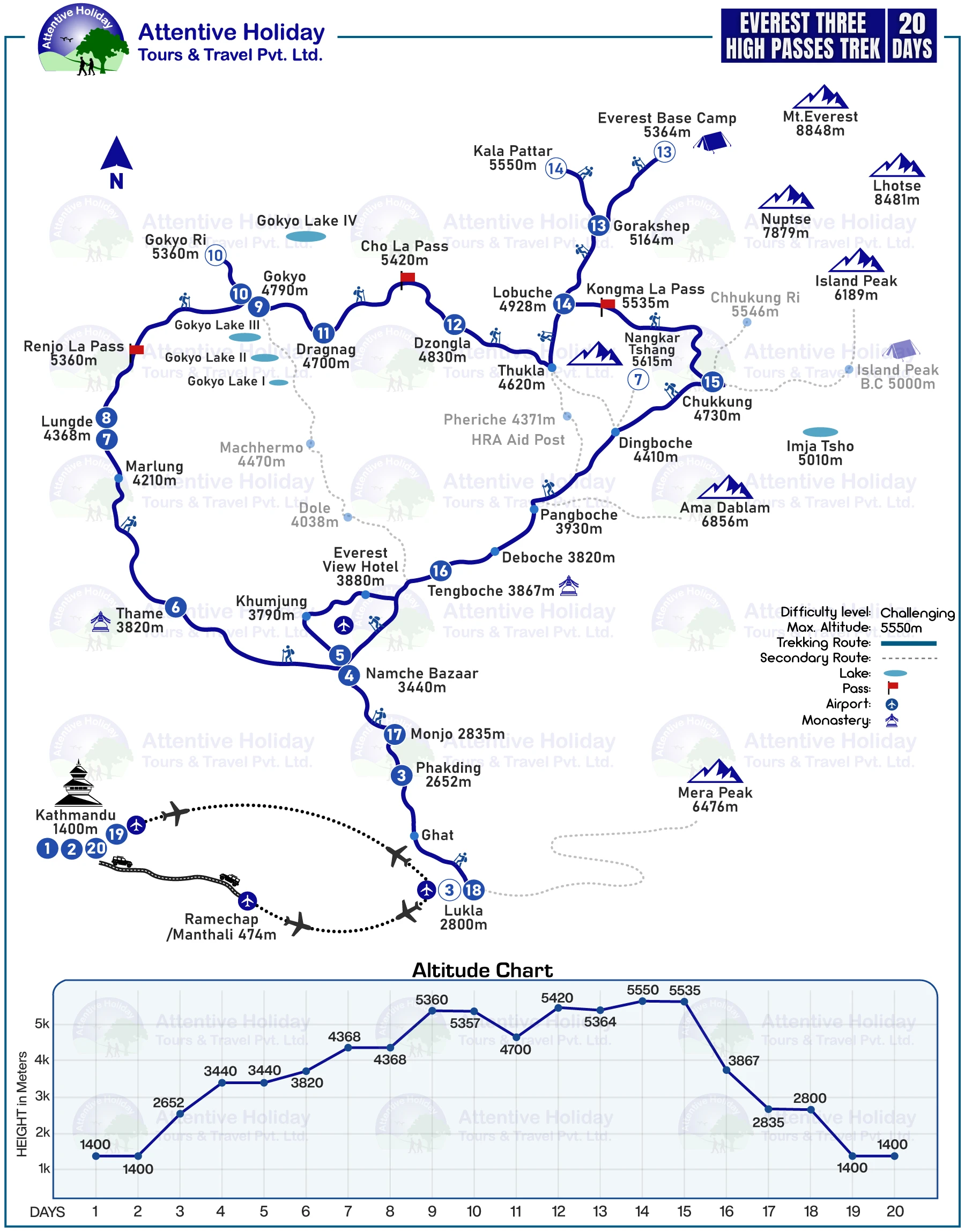
Route Map
Everest Three High Passes Trek MAP
FAQs

Everest Three High Passes Trek is one of the challenging treks in Nepal, so it is hard.

The maximun altitude you'll reach is 5,545 meters at Kalapatthar.

Yes, there are acclimatization days in villages like Namche Bazaar, Dingboche Gorakshep, etc. to get used to the higher altitude.

Spring and Autumn are the best time for Everest Three High Passes Trek.

Beginners are normally not recommended for Everest Three Passes Trek, but with enough physical and mental preparation, this trek is doable.

As flight to Lukla is operated based on weather, flights can get delayed or canceled, so better select package with extra days.

  • Sagarmatha National Park Entry Permit
  • Khumbu Pasang Lhamu Rural Municipality Permit
  • Trekkers Information Management System (TIMS) Card