A complete travel guide to Bisket Jatra Festival 2026, Nepal’s most electrifying New Year celebration. Learn about the centuries-old Newari cultured festival with a guide for visitors as well as locals.
07 Oct, 2026By Ramesh

A complete travel guide to Bisket Jatra Festival 2026, Nepal’s most electrifying New Year celebration. Learn about the centuries-old Newari cultured festival with a guide for visitors as well as locals.
Bisket Jatra Festival in Nepal is one of the country's most dramatic and culturally layered New Year celebrations. Picture this, you are standing in the ancient stone square of the medieval city of Bhaktapur. The smell of incense, mustard oil lamps and marigold garlands is profound in the warm April air.
Somewhere ahead, a Dhime drum erupts into a rhythm so deep you feel it in your sternum. Thousands of bodies surge around you. Some are gripping ropes attached to a towering Bisket Jatra Rath (the sacred chariot). Some are tossing handfuls of orange sindoor (Vermilion powder) into the sky. And rest are just witnessing something truly old and alive.
That is the Bisket Jatra Festival. And if you have never heard of it, let’s dive into its story.
It is a nine-day Jatra (celebration) rooted in Newar mythology, tantric ritual and centuries of living community identity. It is centered in Bhaktapur and extends to the ancient Newar settlement of Madhyapur Thimi.
Every year on Baisakh 1, the Nepali New Year by the Bikram Sambat calendar, Bisket Jatra coincides. Unlike any festival in Nepal, Bisket Jatra is raw, real and ancient to the Newari community.
Whether you're a foreign traveler seeking authentic cultural immersion in the Kathmandu Valley, or a Nepali rediscovering your own heritage.
This guide walks you through the history, mythology, rituals, logistics and details that make the difference between watching a festival and truly experiencing one.
Bisket Jatra Festival is a nine-day Newar festival marking the transition from the Nepali month of Chaitra to Baisakh, which aligns with the Nepali New Year. Let’s start with the name itself. Bisket is believed to be derived from the Newari term “Bi” meaning serpent and “Sket” meaning end or death. And Jatra means festival or celebration. Altogether, Bisket Jatra means the Celebration of the Death of Serpent. This is the mythological side of this festival.
Bisket Jatra is traditionally referred to as “Biska Jatra” by the Newar community. The name has been used in Bhaktapur for centuries. It is also called Vishwodhoj Jatra or Chyacha Gunhuya Jatra, which means “8 nights, 9 days jatra" in Newari. It reflects the precise ceremonial timespan of the festival's rituals.
Calling the Jatra just a new year celebration does not do justice to its significance.
What makes Bisket Jatra in Nepal unique is that it hasn't been polished for tourism unlike South Asian festival culture. The Newar Guthi system organizes and funds every ritual. Guthi is a traditional and communal self help group of the Newari people. The festival is also:
This festival is sustained entirely by its own people and for its own reasons. These are actual jatra traditions that have continued largely unchanged since the Malla period. They have been observed by communities carrying living spiritual and social weight. That's genuinely rare. And that's exactly why Bisket Jatra Bhaktapur is a must experience festival on every Nepal tour itinerary.
Bisket Jatra in Nepal 2026 is celebrated from April 10 to April 18 in Bhaktapur, Nepal. The festival spans nine days from 27 Chaitra to 5 Baisakh, on the Bikram Sambat calendar. The central day is April 14, 2026 which aligns with Baisakh 1 (Nepali New Year). That is when the ceremonial Bisket Jatra Lingo (the Lyo Sin Dyo pole) is pulled down in the Satruhanta Jatra ritual at Lyo Sin Khel, Pottery Square.
Also, the Sindoor Jatra in Thimi falls on April 15. The festival opens April 10 with the iconic Bisket Jatra rath procession and tug of war at Taumadhi Square and closes April 18 with the chariot's final procession and dismantling.
Understanding Bisket Jatra, needs understanding Bhaktapur and its singular place in Nepali history. From the 12th to the 18th century, Kathmandu Valley was divided into three competing but culturally interconnected kingdoms which were all ruled by the Malla dynasty. They were Kathmandu, Lalitpur (Patan) and Bhaktapur. Newar art, temple architecture (pagoda-style) and festival culture in the Valley reached new heights. Bhaktapur Durbar Square which today is a UNESCO World Heritage Site, stands as the finest surviving monument to that era.
Bisket Jatra was born in this world. It is believed that the celebration was formalized by King Jagat Jyoti Malla. He was highly inspired by a local Naga legend that he institutionalized it as a royal state celebration. The rituals like Bisket Jatra chariot processions, the tole rivalries, the raising of Lingo all carry meaning through successive generations of Newar guthi.
Even after the end of Malla dynasty and Bhaktapur’s independence, Biska jatra has always been observed and celebrated. Only once it was canceled which was during the Third plague in 1855. This just shows how deeply this jatra is embedded in Bhaktapur’s identity and culture.
Every great jatra has a great story at its heart. Bisket Jatra has one of the most exciting origin tales in all of Nepali folklore. It also happens to explain almost every major ritual in the festival.
During Malla kings regime, Bhaktapur was home to a princess under a terrible curse. Every man who married her, died by the following morning. No wounds, no cause of death, just inexplicable loss. After several husbands met this fate, the kingdom fell into whispered dread and no one would dare marry her. The curse seemed unbreakable.
Until a young prince with tantric knowledge came. He married the princess and instead of sleeping on their wedding night, he stayed awake. At midnight, he saw two enormous Nagas (sacred serpents) slithering out of the princess's nostrils. The prince drew his sword and cut them down instantly. Something which had never happened until now took place.
The curse was broken. It turned out to be the serpents who had been the killers, striking each husband in their sleep. To commemorate this victory over the cursed serpents’ end, King Jagat Jyoti Malla established Bisket Jatra. The yearly raising and laying down of the Lyo Sin Do (Lingo ) represents this symbolic slaying. The two strips of cloth or bark tied to the top of the pole represent the two serpents displayed as trophies.
This is a less known parallel legend which is equally revealing. According to this legend, a powerful tantric siddha (genius) transformed himself into a tiger to defend Bhaktapur from external enemies. He later took the more peaceful form of a python by his wife’s request. An unforeseen tragic mishap leaves both the siddha and his wife trapped permanently in serpent form during sacred ritual. It's the kind of detail that carries deep symbolic weight in Newar cosmology.
The Lingo (Lyo Sin Dyo) carries this symbolism too. It is a sky-high monument to serpentine power. Transformation and relationship between human will and cosmic force is also depicted by the lingo pole. In Newar tantric thought, nothing has just one meaning. It also symbolizes the fertility axis connecting earth to the heavens.
Bisket Jatra is not an event you can experience in one single afternoon. It's a full nine-day long ritual spread across the ancient toles (neighborhoods) of Bhaktapur and the adjoining Newar settlement of Madhyapur Thimi. During this jatra, four attractions stand out as unmissable. These are the moments that define what Bisket Jatra in Nepal is and why it stands out among the festivals of the Kathmandu Valley.
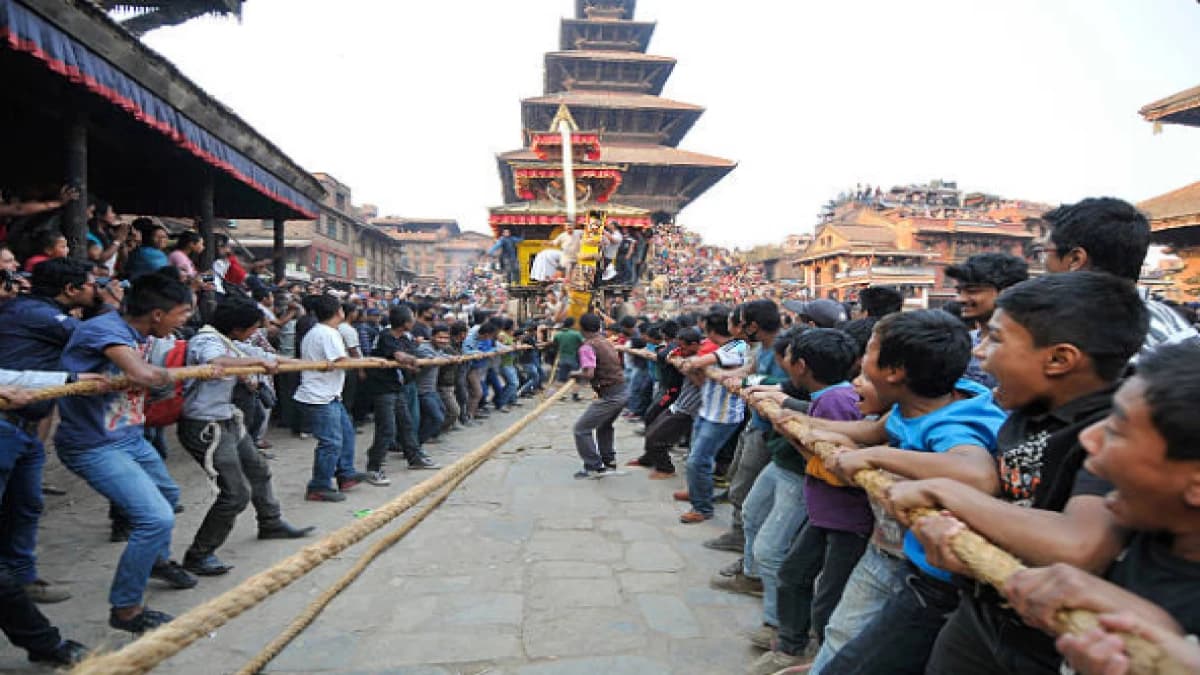
Nothing in the Bisket Jatra 2026 calendar hits quite like the Bisket Jatra Rath tug of war. Nothing prepares you for the scale of it until you're witnessing it. On the first day, the massive wooden chariot bearing Lord Akash Bhairav is rolled into position at Taumadhi Square.
That's one of Bhaktapur's iconic chowks. It is flanked by the five- storied Nyatapola Temple and the Bhairavnath Mandir. The chariot itself is an extraordinary object which is hand-carved with cloth and metalwork. It is built according to traditional chariot construction methods passed through generations of Newar craftsmen.
Then the city splits in two. The Thane tole (upper/eastern Bhaktapur) rivals the Kwochen tole (lower/western Bhaktapur). Thousands of people grip thick jute ropes and pull with full body weight. Dhime drums set a pulse you feel pounding. Sankha (conch shells) blare in unison.
The roar of the crowd is so loud, the pagoda faces of the surrounding temples seem to vibrate. This is not ceremonial pulling for show. People throw their entire weight into those ropes, sometimes tumbling, sometimes bleeding.
The direction the chariot moves first determines which tole claims the auspicious divine vision of Lord Bhairav first that year. It's a matter of neighborhood pride contested for centuries. The tug of war takes place at the jatra’s end on Day 9, with the same contest of devotion and community strength.
The raising of the Bisket Jatra Lingo (the Lyo Sin Dyo) is the most spiritually charged event of Biska Jatra. On Day 4, a freshly cut ‘Sal’ or ‘Simal’ wood pole standing roughly 25 meters is raised at Lyo Sin Khel in Pottery Square. It is done using nothing but ropes, pulleys and coordinated human strength. Families from specific Newar castes and guthi groups have performed this exact role for generations. The erection of the Lingo is a precisely assigned ritual responsibility governed by guthi law, not a casual community event.
The Lyo Sin Dyo is not random timber. It symbolizes the two Nagas from the founding legend. Two strips of sacred bark tied near the pole's crown represent those serpents slain by the tantric prince. Once upright, the Lingo becomes a cosmic pillar linking the terrestrial to the celestial. It becomes a symbol of renewal and the earth's fertility potential for the coming agricultural year.
Then on Baisakh 1, the Lingo is pulled down in the Satruhanta Jatra, meaning “the jatra of killing your enemy." The belief runs deep in people of Bhaktapur. Witnessing the Lyo Sin Dyo crash to earth means your enemies will similarly fall that year. As the pole hits the ground at Lyo Sin Khel, the collective roar from thousands of people is one of the most primal festival sounds you will encounter anywhere in Nepal.
On Day 6, the festival migrates from Bisket Jatra Bhaktapur to Madhyapur Thimi. Thimi is the ancient Newar settlement meaning 'mid-city’. It is located roughly 5 km from Bhaktapur. This is where Sindoor Jatra Thimi unfolds. The celebration is arguably the most visually stunning single day in the entire Bisket Jatra in Nepal calendar.
Sindoor Jatra sees devotees carry 32 khats (palanquins) bearing sacred idols of various local deities through Thimi's narrow, centuries-old brick lanes. As the khats move, people hurl handfuls of sindoor into the air, over everything and everyone in reach. Sindoor is the bright orange-vermillion powder derived from cinnabar. The entire tole bathes in warm saffron haze, smells of powder, incense and devotion within minutes.
Traditional Newari Dhime baja (drum) musicians set a hypnotic rhythm that bounces off the ancient brick faces lining Thimi's lanes. The Balkumari Temple is the sacred seat of Thimi's goddess of protection. It anchors the procession, with all 32 khats revolving around it. Sindoor Jatra has its own distinct origin story and guthi structure rooted in Thimi's local traditions. But it falls squarely within the Bisket Jatra Thimi festival window.
In the Newar village of Bode which is just a short walk away from Thimi, something entirely different unfolds. During the same day as Sindoor Jatra, another celebration which is far more intense takes place. The Tongue-piercing ceremony is one of the most extraordinary acts of devotional endurance in all of Nepali festival culture.
On the day of Sindoor jatra yearly, a single male volunteer from the Shrestha caste, inhabitant of Bode steps forward. A priest drives an iron pin through his tongue. He spends the entire day walking the ritual circuit wearing an iron collar. He bears flaming torches (Mahadip) on his shoulders and maintains complete silence throughout. He does not eat. He does not flinch. He moves through Bode as a living sacred instrument. This is intense and raw.
The belief behind the ceremony is that it shields Bode from drought, epidemic, crop failure and communal misfortune for the coming year. The entire ceremony is financed through the guthi network with no government or tourism money involved. Only Bode's Shrestha lineage members may volunteer for tongue piercing ritual.
Nine days, one city and more happening than any single visitor can catch. Use this Bisket Jatra festival itinerary to plan your time. The major attractions section above gives you the full story behind each key moment.
| Day/ Date | Event |
| Day 1, April 10 | Bhairav Chariot and Tug of War |
| Day 2-3, April 11 and 12 | Worship and Devotion of Bhairav |
| Day 4, April 13 | Raising of the Lyo Sin Do (Lingo) |
| Day 5, April 14 | Nepali New Year and Lingo Pole Lowering |
| Day 6, April 15 | Sindoor Jatra |
| Day 7-8, April 16 and 17 | Sagun Rituals |
| Day 9, April 18 | Final Tug of War and Chariot Dismantling |
Day 1: Tug of War at Taumadhi Square
The festival kicks off with the Bhairav chariot procession and the legendary tug of war between eastern and western Bhaktapur neighborhoods. Arrive early at Taumadhi Square to claim a good vantage point. The crowd builds fast and the energy is unlike anything else on the calendar.
Days 2 & 3: Bhairav Worship
The pace softens into devotion. Bhairav remains in his chariot at Taumadhi Square as a steady stream of devotees offer prayers, flowers and rice. A good time to explore Bhaktapur's quieter corners, pottery workshops, tea shops and the insightful conversations with locals about the city’s rich heritage and culture.
Day 4: Raising the Lyo Sin Dyo
The 25-meter Lingo pole is raised at Pottery Square in a ceremony that is both a community effort and a religious celebration. Head there by mid-morning to watch the preparations. The actual raising, when it happens, is one of the main attractions of the Bisket jatra festival.
Day 5: Nepali New Year and the Pole Falls
Baisakh 1, 2083 BS. The New Year arrives and with it the Satruhanta Jatra. The Lingo is pulled down at Pottery Square as thousands watch. Afterward come offerings, music and a city-wide sense of collective exhale. This is the emotional centerpiece of the entire festival.
Day 6: Sindoor Jatra and Tongue Piercing
The festival splits across two locations. Madhyapur Thimi hosts the dazzling orange cascade of Sindoor Jatra from early morning. The village of Bode holds its tongue-piercing ceremony at the same time. Both are worth attending.
Days 7 & 8: Sagun Rituals
These are the festival's most intimate days. Newar families perform Sagun, ritual offerings of eggs, fish, bara (lentil cakes), aila (rice wine) and meat, each element carrying specific tantric meaning.
Day 9: Final Tug of War
The chariot of Bhairav is taken back to Taumadhi Square for a closing tug of war before being dismantled for next year. This day is bittersweet. The city begins returning to its rhythms, carrying the festival's invisible threads of identity and memory with it.
You could attend Bisket Jatra purely as a visual experience. The Bisket Jatra rath, the sindoor clouds, the Lingo rising. You'd leave deeply satisfied. But if you want to go deeper, here's what is actually happening beneath the spectacle.
The tug-of-war isn't an arbitrary neighborhood rivalry. The division of Bhaktapur into the Thane (upper/eastern) and Kwochen (lower/western) toles runs through every dimension of Newar civic life. It decides who gets to receive Lord Bhairav's holy sight (darshan) first each year.
It maps onto a fundamental Newar cosmological framework of paired opposites: Dyo and Ajima (male and female divine principles). The Bisket Jatra rath is the sacred object that mediates between these poles. Whoever holds it first holds cosmic prestige for the year.
The Bisket Jatra Lingo isn't a dramatic prop. It's a loaded cosmological statement. In Newar tantric cosmology, Nagas are associated with underground water, agricultural fertility and the earth's generative power. The raising of the Lyo Sin Dyo is the serpent ascending, bringing with it the monsoon potential and harvest energy of the new Baisakh year.
The fall of Satruhanta is the serpent’s defeat. The completion of the tantric prince's victory over chaotic serpentine forces. Both the raising and the lowering are essential. One without the other would leave the ritual cycle incomplete.
Lord Bhairav is the territorial guardian deity of Bhaktapur city. He is eight-armed, fanged and draped in a garland of skulls. His power, Bhadrakali, is equally fierce and equally essential. During Bisket Jatra in Nepal, their chariots are the axis around which the entire city rotates.
These are not approachable, devotional deities in the bhakti tradition sense. They are fierce protectors who demand to be honored with intensity, noise, animal sacrifice and community mobilization. The festival's raw energy is a direct reflection of the deities it honors.
Bhaktapur is about 13 km east of Kathmandu city’s center. There are several options of getting to Bhaktapur from Kathmandu. The journey is normally a 30 to 45 minute drive. But during the festive time of Bisket Jatra, road diversions, crowds and sheer foot traffic around the area slow you down. You can get to Bhaktapur by:
Private Transport or Tour package
This is the most comfortable and hassle free way of transportation to Bhaktapur. You don’t have to worry about missing stops, going the wrong way or finding where the actual Jatra is taking place. Your private transport or tour guide knows where to stand, when to move and which alley leads to the best vantage point for observing Bisket jatra.
Taxi
It is the most flexible option in terms of cost and comfortability. It takes around 30 to 45 minutes in normal traffic. The price is generally around USD 10 to 12.
Local Bus
If you don’t mind the hassle and want to experience local transport in Nepal, this is for you. It is time consuming, irregular and you might face trouble finding the correct way to the jatra after getting off at your stop.
You don’t need to pay for any special permit just for the Bisket Jatra festival. However, the jatra is held in the courtyards of Bhaktapur Durbar Square. Hence, you do need to pay for the entry fee to access the UNESCO listed world heritage site. The entry fee for Bhaktapur Durbar square is:
| Nationality | Cost |
| Foreign Nationals | USD 18 approximately |
| SAARC and Chinese Nationals | NPR 500 |
The April days in Bhaktapur run warm with temperatures from 20 to 30°C (68 to 86°F). Nights can be cooler, especially early in the festival period. Here's your packing checklist:
Bisket Jatra Festival involves very large crowds in relatively narrow streets which do pose accident risks. The tug of war can get genuinely intense. Some sources actually classify it among the more physically demanding festivals in the world to attend. None of this should scare you off. But it should inform your approach. Follow the given safety approach and you will be fine:
One of the underrated pleasures of visiting Bhaktapur during the festival is its food. The city has its own distinctive Newari cuisine and the festival season brings out the best of it. These are some of the Newari Foods to try during Bisket Jatra any time you visit the city of Bhaktapur.
Juju Dhau (King Curd)
Bhaktapur's most famous culinary item which is popular throughout the Kathmandu valley. A thick, slightly sweet buffalo-milk yogurt set in clay pots. They are sold in Pottery Square and throughout the city.
Bara
Crispy lentil cakes, often topped with egg or minced meat. Street food perfection.
Chatamari
Sometimes called Newar pizza. Rice flour crepes with toppings. You can find them near Taumadhi Square.
Samay Baji
The traditional Newar festival plate. Beaten rice, black soybeans, boiled egg, meat and aila. This is the Sagun offering made edible and it's extraordinary.
Aila (Rice wine)
The local rice spirit. If you're invited to share a cup during a family Sagun gathering, accepting gracefully goes a long way toward genuine connection.
Bhaktapur is a UNESCO World Heritage site and a living city. The people celebrating Bisket Jatra are not performing for the camera. They're doing something sacred that their families have done for generations.
There is a particular quality to Bisket Jatra in Nepal that is hard to put into words. It's the feeling of standing somewhere genuinely ancient. The square roars with the same old Dhime drum beats like they used to in the 1600s.
An entire city of Newar people believes collectively in the Naga mythology to sustain nine days of guthi-organized ritual and thousands of hours of voluntary community labor, year after year and century after century.
For travelers, Nepal has the Everest, Annapurna and the trekking routes that have defined adventure travel for generations. But if you want to understand what Nepali civilization actually feels like from the inside, Bisket Jatra Bhaktapur is essential. Nothing else conveys the intellectual and spiritual richness of the Kathmandu Valley's Newar heritage, the depth of tantric traditions, quite like watching a Bisket Jatra rath procession hold centuries of meaning in a single afternoon.
Bisket Jatra 2026 falls on April 10 through April 18. The Lingo falls on Baisakh 1, April 14. The world turns orange in Thimi on April 15. The drums will start before dawn. Be there and witness it while it's still alive.
1. Which king started the Bisket Jatra festival?
The Bisket Jatra festival was started by King Jagat Jyoti Malla of Bhaktapur during the Malla dynasty era.
2. Why is Bisket Jatra celebrated?
Bisket Jatra is celebrated to mark the Nepali New Year, honor the guardian deities Bhairav and Bhadrakali and commemorate the breaking of an ancient serpent curse rooted in Bhaktapur's mythology.
3. When is Bisket Jatra celebrated in Nepali date?
Bisket Jatra is celebrated every year on the Nepali New Year on Baisakh 1 of the Bikram Sambat, following the solar calendar. It falls in in mid-April as per English date.
4. Which days of Bisket Jatra are most worth attending?
If you can only attend one or two days, prioritize Day 1 (April 10) for the Chariot tug of war spectacle and Day 6 (April 15) for Sindoor Jatra in Thimi. Day 4 (April 13) for the Lingo-raising is the best option for those who want ceremony over spectacle.
5. Is Bisket Jatra the same as Sindoor Jatra?
Sindoor Jatra is a distinct festival with its own origin, celebrated in Madhyapur Thimi. It occurs during the Bisket Jatra period (Day 6) and is considered part of the broader Bisket Jatra celebrations by many. They are related but not identical.